Hashcash proposes proof of work
Adam Back announced a scheme that required a sender to burn measurable computation before a message would be accepted.
THE HISTORY OF AN IDEA IN MOTION
Follow the breakthroughs, arguments, crises, and unlikely moments that carried Bitcoin from a cryptography mailing list into world history.
Ride through Bitcoin history in 3D: a roller coaster shaped by its price, with an exhibit at every stop.
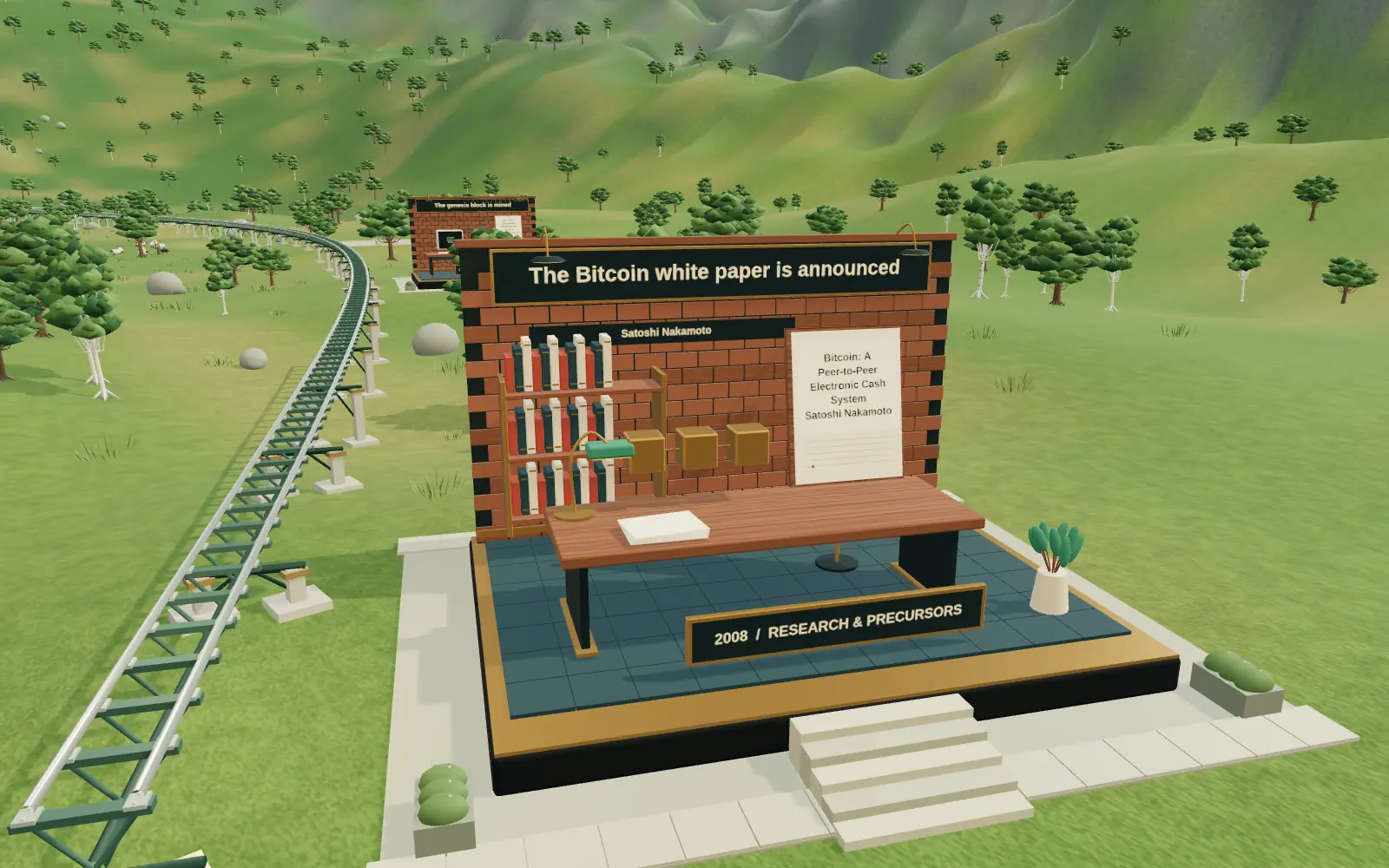 ▶THE GRAND TOUR · 32 STOPSScroll to explore the events
EXPLORE THE ARCHIVE
VISIBLE CHAIN
Adam Back announced a scheme that required a sender to burn measurable computation before a message would be accepted.
Wei Dai circulated a proposal for money whose creation and ownership were tracked by every participant rather than an issuer.
Satoshi Nakamoto emailed Wei Dai about citing b-money in a forthcoming electronic-cash paper.
Satoshi Nakamoto announced “Bitcoin: A Peer-to-Peer Electronic Cash System” on the Cryptography Mailing List.
Satoshi Nakamoto created Bitcoin’s first block and embedded a newspaper headline in its coinbase data.
Satoshi Nakamoto released the first public Bitcoin software and announced it on the Cryptography Mailing List.
Satoshi Nakamoto sent 10 BTC to Hal Finney in Bitcoin’s first known transfer between two people.
Nakamoto introduced the running software to a wider audience and stated the problem it was built to solve.
Martti Malmi sold 5,050 BTC to New Liberty Standard for $5.02 sent through PayPal.
Satoshi Nakamoto launched a dedicated discussion board, later known as BitcoinTalk, for the growing project.
Bitcoin Market launched as the first publicly announced marketplace dedicated to trading bitcoin for conventional currency.
Programmer and miner Laszlo Hanyecz posted an offer to pay 10,000 BTC for two delivered pizzas.
Jeremy Sturdivant arranged two pizzas for Laszlo Hanyecz in exchange for 10,000 BTC.
The miner known as ArtForz began producing blocks with an OpenCL GPU setup during Bitcoin’s first mining-technology shift.
Jed McCaleb opened Mt. Gox for bitcoin trading after repurposing a domain originally created for game-card exchange.
A validation bug allowed one transaction in block 74,638 to create outputs totaling more than 184 billion bitcoin.
Bitcoin Pooled Mining, later known as Slush Pool, found its first mainnet block using cooperative hash power.
One bitcoin traded for one U.S. dollar on Mt. Gox for the first time.
Jed McCaleb sold the Mt. Gox exchange to Mark Karpelès as trading activity expanded.
Satoshi Nakamoto sent Gavin Andresen a final known message emphasizing the project and its contributors rather than the founder.
A widely read Gawker article described Silk Road and its use of bitcoin for transactions.
WikiLeaks began accepting bitcoin donations after card networks and PayPal cut off its funding.
A compromised account enabled fraudulent trades that briefly drove Mt. Gox’s displayed bitcoin price to one cent.
BIP 1 defined how proposals to alter Bitcoin would be written, discussed and recorded.
BIP 32 let an entire wallet's keys be derived from a single seed value.
Bitcoin activated BIP 16, allowing payments to a script hash rather than exposing the full spending conditions in advance.
A Y Combinator-backed startup set out to make buying bitcoin as simple as using a consumer web app.
Trendon Shavers announced the closure of Bitcoin Savings and Trust after promising unusually high bitcoin-denominated returns.
Industry participants launched the Bitcoin Foundation to support development, advocacy, and adoption.
At block 210,000, Bitcoin’s block subsidy fell from 50 BTC to 25 BTC.
Avalon delivered the first purpose-built Bitcoin mining chips to customers.
A large block accepted by Bitcoin 0.8 nodes was rejected by many older nodes, splitting the network into two chains.
The U.S. Financial Crimes Enforcement Network distinguished ordinary users from administrators and exchangers under money-services rules.
A federal judge held that bitcoin could be used as money and that Bitcoin Savings and Trust interests could fall under securities law.
BIP 39 encoded a wallet's master secret as an ordered list of common words.
A private placement began offering exposure to bitcoin through a conventional securities wrapper.
Federal agents shut down the Silk Road marketplace and arrested alleged operator Ross Ulbricht.
A Robocoin kiosk opened at a Vancouver coffee shop, allowing customers to buy and sell bitcoin for cash.
Senators, regulators, law-enforcement officials, and industry witnesses examined the risks and potential of virtual currencies.
Chinese authorities classified bitcoin as a virtual commodity and barred financial and payment institutions from providing Bitcoin-related services.
A forum user posted a misspelled, half-drunk defence of refusing to sell during a crash.
Overstock.com became the first major online retailer to accept bitcoin across its U.S. catalog.
Mt. Gox suspended bitcoin withdrawals while citing technical problems and transaction malleability.
Mt. Gox sought bankruptcy protection in Japan after reporting that approximately 850,000 BTC were missing.
A cover story identified a 64-year-old engineer in Temple City, California, as Bitcoin's creator.
The U.S. Internal Revenue Service said convertible virtual currency would be treated as property for federal tax purposes.
The GHash.io mining pool produced more than half of Bitcoin’s blocks over a short observation window.
The New York Department of Financial Services published proposed licensing rules tailored to virtual-currency businesses.
The cryptographer who received the first bitcoin transaction died of ALS at 58.
Realcoin, later renamed Tether, issued its first dollar-denominated tokens on Bitcoin through the Mastercoin protocol, now known as Omni Layer.
A company formed to fund Bitcoin protocol engineering, employing several of its most active contributors.
Coinbase opened an order-book exchange for professional bitcoin trading in parts of the United States.
Joseph Poon and Thaddeus Dryja described how to move bitcoin payments off the blockchain without trusting a custodian.
The New York Department of Financial Services issued its final regulatory framework for virtual-currency businesses.
Bitcoin began enforcing strict DER signatures, after which miners building without full validation produced short invalid chains.
Mike Hearn released Bitcoin XT with BIP 101 support for a miner-activated increase to Bitcoin’s block-size limit.
In an enforcement order against Coinflip, the U.S. Commodity Futures Trading Commission held that bitcoin and other virtual currencies are commodities.
The Court of Justice of the European Union ruled that exchanging bitcoin and traditional currencies is exempt from value-added tax.
Developers and mining companies signed a statement pairing Segregated Witness with a later block-size increase.
Australian computer scientist Craig Wright told several media organizations that he was Bitcoin creator Satoshi Nakamoto.
Japan’s Diet approved amendments recognizing virtual currency as an asset-like means of payment and regulating exchange operators.
Bitcoin activated BIPs 68, 112, and 113, enabling consensus-enforced relative timelocks and CHECKSEQUENCEVERIFY.
At block 420,000, Bitcoin’s block subsidy fell from 25 BTC to 12.5 BTC.
A security breach removed approximately 119,756 BTC from Bitfinex customer wallets and forced the exchange to halt operations.
Bitcoin Core v0.13.1 included validation and miner-signaling support for the Segregated Witness soft fork.
An exchange founded weeks before China's crackdown grew into the largest venue in the market.
U.S. authorities charged BTC-e and alleged operator Alexander Vinnik after the exchange was disrupted by law enforcement.
BIP 148 nodes began rejecting blocks that did not signal support for Segregated Witness.
A group favoring larger on-chain blocks launched Bitcoin Cash through an incompatible fork of Bitcoin's transaction history.
Miner signaling reached the threshold that locked in Segregated Witness for activation during the next difficulty period.
SegWit activated at block 481824, introducing a new transaction format and effective block-weight system.
Backers of SegWit2x suspended its two-megabyte hard fork after concluding that the change lacked sufficient consensus.
Valve removed bitcoin payments, citing high fees and price volatility during the transaction window.
The 2017 rally topped out just under $20,000 before losing more than four fifths of its value.
CME Group began trading a cash-settled Bitcoin futures contract based on its regulated reference rate.
Lightning Labs released lnd 0.4-beta with support for real-value channels on Bitcoin mainnet.
Bitcoin Core 0.16.3 fixed a flaw that allowed both a crash and, in some versions, the creation of coins from nothing.
Binance disclosed that attackers withdrew 7,000 BTC from one of its hot wallets in a coordinated security breach.
The Financial Action Task Force adopted guidance applying anti-money-laundering standards, including transfer information duties, to virtual-asset service providers.
BIPs 340, 341 and 342 set out Schnorr signatures, Taproot outputs and a new scripting version.
The court held that the central bank's order cutting exchanges off from banking was disproportionate.
Bitcoin fell roughly 40 percent intraday as global markets rushed toward cash during the early COVID-19 shock.
Block 630000 cut Bitcoin's per-block subsidy from 12.5 BTC to 6.25 BTC.
The Office of the Comptroller of the Currency said national banks and federal thrifts may provide cryptocurrency custody services.
MicroStrategy announced a $250 million purchase of 21,454 BTC as part of a new capital-allocation strategy.
Payments company Square announced that it had purchased approximately 4,709 BTC for its corporate balance sheet.
PayPal said U.S. customers would be able to buy, hold, and sell bitcoin and use supported crypto balances at checkout.
The Justice Department filed a civil forfeiture complaint after taking control of bitcoin allegedly connected to the Silk Road marketplace.
The central bank directed financial institutions to identify and close accounts tied to cryptocurrency exchanges.
Tesla's annual filing disclosed that the company had invested $1.5 billion in bitcoin under a revised treasury policy.
Purpose Investments launched a physically backed Bitcoin ETF on the Toronto Stock Exchange.
Coinbase shares began trading through a direct listing on Nasdaq under the ticker COIN.
A State Council financial committee called for cracking down on Bitcoin mining and trading activities.
President Nayib Bukele announced that he would send legislation making Bitcoin legal tender to El Salvador's assembly.
U.S. authorities seized about 63.7 BTC of the ransom Colonial Pipeline had paid to the DarkSide group.
El Salvador's Legislative Assembly approved a law giving Bitcoin legal-tender status alongside the U.S. dollar.
Miner signaling met the Speedy Trial threshold, locking Taproot in for activation at block 709632.
Bitcoin's largest ever downward difficulty adjustment followed China's removal of roughly half the network's hash rate.
Bitcoin's legal-tender status began in El Salvador as the government launched the Chivo wallet and related infrastructure.
Chinese authorities issued a coordinated notice treating a broad range of virtual-currency trading services as illegal financial activity.
ProShares listed a fund holding bitcoin futures rather than bitcoin itself.
Bitcoin traded near $69,000 on major dollar markets before beginning a prolonged decline.
Taproot activated at block 709632, adding Schnorr signatures, new spending rules, and more flexible scripts.
Invoking the Emergencies Act, the government directed banks to freeze accounts tied to the trucker convoy, and named crypto addresses.
Ukraine's government shared bitcoin and other cryptocurrency addresses for donations after Russia's full-scale invasion.
President Joe Biden signed an executive order directing coordinated federal work on digital-asset risks and opportunities.
The Central African Republic announced legislation making Bitcoin legal tender alongside the CFA franc.
TerraUSD lost its intended dollar peg and the associated LUNA token entered a hyperinflationary collapse.
European negotiators reached a provisional agreement on the Markets in Crypto-Assets regulation.
The U.S. Treasury added the Tornado Cash mixing contracts to its sanctions list.
FTX Trading and more than one hundred affiliates entered U.S. bankruptcy proceedings after a rapid liquidity crisis.
Casey Rodarmor released the Ordinals protocol and tooling for tracking individual satoshis and attaching inscriptions to them.
A revised cryptocurrency law removed legal-tender status and guaranteed convertibility for crypto assets in the Central African Republic.
The Council completed the legislative adoption of the Markets in Crypto-Assets regulation.
The agency filed suit against the largest offshore exchange and the largest U.S. one within twenty-four hours.
Nasdaq filed to list BlackRock's proposed iShares Bitcoin Trust as a commodity-based trust holding bitcoin.
The D.C. Circuit vacated the SEC's denial of Grayscale's proposal to convert GBTC into a spot Bitcoin ETP.
Binance agreed to more than $4 billion in U.S. resolutions and founder Changpeng Zhao pleaded guilty to an anti-money-laundering charge.
The Financial Accounting Standards Board required qualifying crypto assets such as bitcoin to be measured at fair value each reporting period.
The SEC approved exchange rule changes allowing multiple spot Bitcoin exchange-traded products to list in the United States.
New spot Bitcoin products began trading on Nasdaq, NYSE Arca, and Cboe alongside Grayscale's converted trust.
At the close of trial, the High Court declared that Craig Wright did not create Bitcoin, write its white paper, or use the Satoshi Nakamoto identity.
Block 840000 cut the block subsidy from 6.25 BTC to 3.125 BTC.
U.S. prosecutors charged the developers of a bitcoin privacy wallet with money laundering and unlicensed money transmission.
The Mt. Gox rehabilitation trustee made the first bitcoin and bitcoin cash repayments through designated exchanges.
At a Bitcoin conference in Nashville, presidential candidate Donald Trump pledged that a future administration would retain federal bitcoin holdings.
Bitcoin crossed the $100,000 level on major dollar markets for the first time.
An IMF staff-level financing agreement called for voluntary private Bitcoin acceptance and reduced public-sector participation.
The main provisions of the EU Markets in Crypto-Assets regulation began applying after its staged implementation period.
President Trump granted a full pardon to the Silk Road founder, who had served more than eleven years of a life sentence.
Staff Accounting Bulletin 122 removed the SEC staff guidance that had required certain crypto custodians to record safeguarding assets and liabilities at gross fair value.
President Donald Trump signed an order promoting lawful public-blockchain use and creating a presidential working group on digital-asset markets.
El Salvador's assembly amended the Bitcoin Law to remove mandatory private acceptance and limit public-sector involvement.
Attackers redirected a routine cold-to-hot wallet transfer, taking the largest single haul in the industry's history.
President Donald Trump ordered the creation of a reserve capitalized with federally held bitcoin that had been finally forfeited.
Bitcoin's estimated hashrate crossed 10^21 hashes per second for the first time.
Tether, Bitfinex and SoftBank backed a new bitcoin-treasury company set to go public through a Cantor Fitzgerald SPAC.
Governor Kelly Ayotte signed HB 302, allowing the state treasurer to invest up to five percent of specified funds in qualifying digital assets and precious metals.
The prime minister's special assistant on blockchain and crypto unveiled a government-backed bitcoin reserve at the Bitcoin 2025 conference.
Texas SB 21 took effect after the governor signed legislation creating a special reserve outside the state treasury.
A market-structure bill dividing oversight between the SEC and CFTC passed 294 to 134 with bipartisan support.
The GENIUS Act became federal law, creating a regulatory framework for permitted payment stablecoin issuers.
A New York jury found the Tornado Cash co-founder guilty of conspiring to operate an unlicensed money-transmitting business and deadlocked on money-laundering and sanctions charges.
President Trump directed the Labor Department and the SEC to ease the way for digital assets and other alternatives in workplace retirement plans.
The price peaked at roughly $126,000, the highest level Bitcoin has traded at.
The release raised the default size of data a node will relay in an OP_RETURN output, splitting the developer community.
More than $19 billion of leveraged positions were forcibly closed in twenty-four hours after a tariff announcement.
The Binance founder received a full pardon, erasing the conviction that followed his 2023 guilty plea.
The central bank set up a $1 million test portfolio holding bitcoin, a dollar stablecoin and a tokenized deposit.
The price fell below $61,000, more than 50% down from October's high, in the weakest opening fifty days Bitcoin has had.
A proposal for a new output type that avoids exposing public keys was merged into the BIP repository as a draft.
Bitcoin's cumulative issued supply crossed 20 million BTC at block 940,000.
The largest corporate holder traded below the value of its own bitcoin and began disposing of coins.
An attacker swept about 1,816 BTC from more than 5,200 addresses whose seeds had been generated with predictable randomness.
A motion to begin debate on the market-structure bill failed 49 to 50, short of the 60 votes cloture requires.
HOW WE KNOW
Every record includes a direct source wherever one survives: blocks and transactions, BIPs and release notes, court records and enacted laws.
Claims are labelled when dates are estimated or interpretations are disputed. Exchange failures are never described as protocol failures.
The archive is editorially reviewed, versioned, and designed to accept corrections without silently rewriting the past.